
Manage the Agreement Before Reviewing a Missed Payment
Settlement instalments require a clear record of what the parties agreed, what has actually been paid and what remains due. Once a legal notice has led to an agreed payment plan in Pakistan, the immediate task changes: both sides need to perform and document that agreement, rather than repeat the original demand.
A useful file connects each due date to the correct payment, receipt and balance. It also records any agreed extension, deduction or release. When a payment appears late, that evidence helps distinguish a banking delay, a recording error and an actual failure to meet the operative terms.
This guidance concerns agreements already reached. For checking the underlying invoices, credits and earlier receipts before making a demand, use the separate unpaid-invoice notice and payment-reconciliation guide. An agreed payment plan creates a later monitoring exercise, with different documents and questions. Have the signed terms and payment history reviewed before asserting default or abandoning an existing remedy.
Establish the Operative Terms of the Payment Plan
Start with the final accepted version, including its schedules and any subsequent amendment. Draft offers, unaccepted proposals and the original legal notice should remain in the file, but they should not silently replace the terms under which the parties are now performing. Mark each document with its date and status.
For settlement instalments, extract the agreed total, payment amounts, due dates, recipient account and method of payment. Identify whether the plan includes a deposit, a final balancing payment or non-monetary obligations. Record the named parties and the authority of any representative who agreed or later changed the arrangement.
Identify What Changed and What Remains Payable
Sections 62 and 63 of the Contract Act, 1872 address agreed substitution, rescission or alteration, and the promisee’s ability to remit performance, extend time or accept another satisfaction. The legal effect depends on the actual arrangement; a reduced payment plan does not answer every question about the original claim.
Check whether a discount is immediate or conditional on complete, punctual performance. Ask whether an original balance survives, is replaced or is released at a defined stage. These distinctions matter when reviewing settlement instalments: an administrator should not restore a waived amount merely because a spreadsheet has a blank payment cell.
Build a Record for Every Scheduled Payment
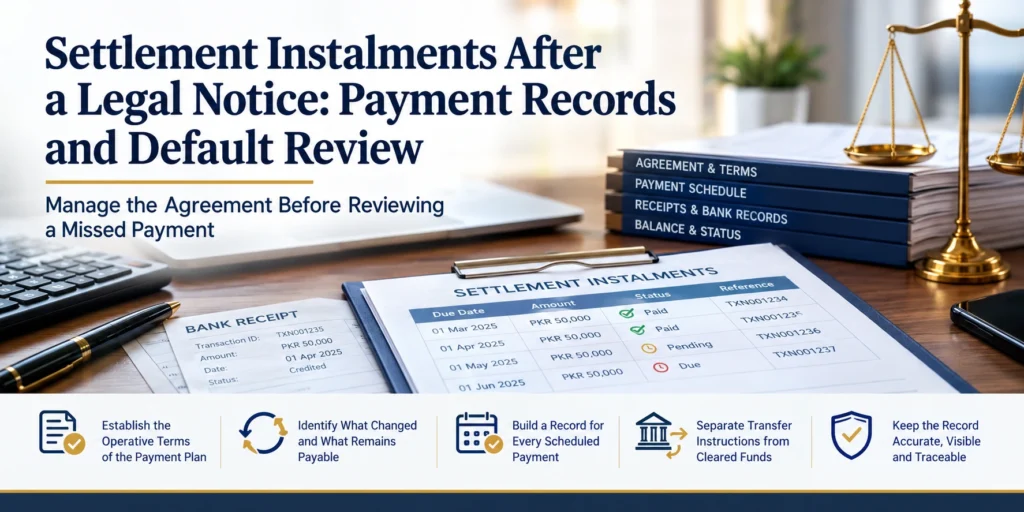
A register for settlement instalments should show the promised date and amount alongside the actual receipt date, amount received, transaction reference and allocation. Keep the supporting bank record or signed receipt beside that entry. A running total is useful, but it cannot explain a disputed entry without its underlying evidence.
Use one responsible person on each side for routine confirmations. Settlement instalments are easier to verify when both parties use the same agreement reference and instalment number. An acknowledgment should identify the payment it records, without accidentally describing an incomplete payment as complete satisfaction of all obligations.
Separate Transfer Instructions from Cleared Funds
A transfer screenshot may show that an instruction was initiated, not that the intended recipient received usable funds. Record the status accurately: initiated, pending, credited, reversed or returned. For a cheque, retain its identifying details and subsequent bank record rather than treating delivery of the instrument as proof of final clearance.
Where cash is accepted, obtain a dated receipt identifying the payer, authorised recipient, amount and agreement reference. Avoid unnecessary circulation of full bank-account details or identity documents. Store originals securely and send only the evidence necessary to resolve the payment question through the parties’ established communication channel.
Do not delete an incorrect entry after discovering it. Correct it visibly, explain the reason and preserve the earlier record. This makes settlement instalments traceable when a later reviewer needs to understand why the balance changed.
Allocate Settlement Instalments Without Double Counting
Payment allocation identifies which obligation a receipt satisfies. Sections 59–61 of the Contract Act’s appropriation provisions address several distinct debts: an accepted payment follows the debtor’s indicated debt; absent an indication, the creditor may choose a lawful debt actually due; absent either appropriation, payments generally follow time order, with equal-standing debts treated proportionately.
When allocating settlement instalments, preserve the payer’s payment reference and accompanying message. If those conflict with the agreement or the receiving ledger, raise the discrepancy promptly. Do not quietly apply the money elsewhere and then describe the identified instalment as wholly unpaid.
Distinguish Separate Debts from Components of One Balance
Those statutory provisions concern distinct debts; they do not supply a universal formula for splitting every receipt between principal, charges and costs within one consolidated obligation. Settlement instalments may be governed by an agreed allocation clause. Examine that clause and the legal basis of each component instead of assuming that the oldest invoice always remains the operative debt.
Keep disputed charges in a separate line from the undisputed unpaid balance. If a payment covers two obligations, document the split and its basis. A sum cannot count simultaneously as a settlement receipt and as a separate payment reducing the same underlying balance again.
Reconcile the Running Balance with a Worked Example
The following illustration assumes a fixed agreed balance of PKR 600,000, payable through three monthly instalments of PKR 200,000. It assumes no interest, costs, conditional discount or acceleration clause. These are example terms, not a recommended contract or a statement of a client’s position.
| Scheduled Payment | Confirmed Receipt | Unpaid Total |
|---|---|---|
| First: PKR 200,000 | PKR 200,000 credited and allocated | PKR 400,000 |
| Second: PKR 200,000 | PKR 150,000 credited and allocated | PKR 250,000 |
| Third: PKR 200,000, not yet due | No receipt recorded | PKR 250,000 total remains unpaid |
After the second due date, PKR 50,000 of that scheduled payment remains outstanding. The other PKR 200,000 is scheduled for the future. Calling the entire PKR 250,000 overdue would confuse the unpaid total with the presently due amount unless another operative provision lawfully changes when it becomes payable.
Registers for settlement instalments should therefore show at least two totals: unpaid overall and currently overdue. Add a third field for sums whose allocation is disputed. This separation helps both sides identify the actual issue without inflating the demand or overlooking a short payment.
If a receipt is later reversed, retain both the original credit and the reversal evidence. Recalculate the balance and review the legal consequences separately. Settlement instalments can produce accounting changes without automatically resolving whether the agreement’s default conditions have been met.
Experienced Legal Review of Late or Partial Payments
Before issuing a default allegation, compare the agreed deadline with the payment method, receipt evidence and any extension. Read whether the agreement measures payment by dispatch, account credit or another defined event. Check the specified recipient and whether changed bank instructions were properly communicated and authenticated.
Ask for missing evidence using a precise reference: the relevant instalment, amount, due date and apparent shortfall. Give the other party an opportunity to identify a misallocated receipt or demonstrate payment. That factual check can prevent a needless dispute while preserving a clear record of the concern.
Check the Trigger Before Demanding the Entire Balance
A missed date does not, by itself, establish that every future instalment is immediately due. Review the actual acceleration wording, any notice requirement, agreed opportunity to remedy the failure and previous variations. Do not invent a statutory grace period or assume that every agreement contains the same cure mechanism.
Default charges also require scrutiny. Section 74 of the Contract Act provides for reasonable compensation, subject to the stipulated ceiling, where its conditions apply; the written penalty is not automatically awarded in full. Increased default interest may engage that provision. No standard daily penalty can safely be imposed on every payment plan.
A review of settlement instalments should end with a reasoned position: correct the record, request performance, document an agreed adjustment or obtain advice on the available remedy. It should not jump from one missing receipt to unsupported threats or a guaranteed litigation outcome.
Document Extensions, Discounts and Revised Dates
When parties allow more time for settlement instalments, preserve the precise change, its date and who approved it. Identify the affected payment and whether later dates remain unchanged. A message saying “next week is fine” can create uncertainty about which obligation it covers and whether other rights or conditions were also altered.
For revised settlement instalments, retain the old schedule and attach the new one rather than replacing history. Record whether payments already made keep the same allocation. Clarify how the revision affects conditional discounts, security and any earlier default allegation; these issues should not be left to an accounting assumption.
If a guarantor, security provider or court proceeding is involved, obtain advice before agreeing a variation. Their position may require separate consideration. Neither an informal extension nor a reservation-of-rights sentence guarantees that every original remedy continues unchanged.
The revision should be understandable without a long chain of messages. A dated confirmation can list the revised dates, remaining balance, unchanged provisions and parties’ acceptance. Settlement instalments then remain manageable even when personnel change or the file passes to a different adviser.
Distinguish a Private Agreement from a Court Compromise
A private agreement reached after a legal notice is not automatically a court decree. Where a suit is pending, Order XXIII Rule 3 of the Code of Civil Procedure, 1908 provides for the court to record a lawful adjustment, compromise or satisfaction when satisfied of it, and pass the corresponding decree so far as it relates to the suit.
For settlement instalments reflected in court proceedings, obtain the actual order and decree, not only the parties’ proposed terms. Check what the court recorded and whether the payment provisions relied upon appear in the operative document. Applicable amendments and procedural requirements must be checked for the relevant jurisdiction.
A private default and non-compliance with an existing decree may call for different procedural steps. Do not assume that a fresh legal notice is the only route, or that a signed private agreement can simply be executed as a decree. For related representation issues, RightLaw’s civil-law practice information provides a relevant owned-network starting point.
Before withdrawing pending proceedings or signing a final satisfaction, have the consequences reviewed. Settlement instalments can continue for months after agreement; the file should preserve the legal basis for performance throughout that period, without promising that a particular enforcement route will succeed.
Check Limitation Separately from the Payment Calendar
Do not assume that every receipt, reminder or settlement discussion restarts limitation. Section 19 of the Limitation Act, 1908 concerns a qualifying signed written acknowledgment before the existing period expires. Section 20 addresses qualifying payment before expiry and includes requirements concerning written acknowledgment of that payment.
The applicable claim, starting date, signature or authority, timing and statutory conditions all need review. A creditor’s own reminder is not the debtor’s acknowledgment. Nor should a person assume that an already time-barred claim is revived merely because negotiations resume or a small sum is transferred.
Maintain a separate limitation review date alongside settlement instalments. Give the adviser the original transaction documents, agreement, payment evidence, acknowledgments and any court orders. Where expiry may be close, seek advice promptly rather than waiting for the next promised payment to establish whether protective action is needed.
Close the File with a Defined Discharge
When the last payment arrives, verify clearance, allocation and completion of any remaining obligations. Compare the receipt total with the operative agreement and all approved variations. Settlement instalments should end with a clear account of what has been satisfied, not merely a bank balance that appears approximately correct.
A completion statement for settlement instalments should identify the agreement, final receipt and obligations discharged. Address the treatment of security documents, original instruments and any pending proceedings through the appropriate authorised process. Do not sign a broad release that unintentionally covers an unrelated liability or leave a satisfied obligation showing as outstanding.
For a notice or response about disputed settlement instalments, the legal-notice drafting services guide explains the wider drafting context. Request a document-specific review with the agreement, current register and supporting receipts. The next communication should accurately state the obligation, evidence and requested action, without assuming that a template or notice guarantees payment.
This is general information on Pakistani civil and contract-law issues. The agreement, applicable law, jurisdiction, evidence and any court order require individual review before action.
Frequently Asked Questions
What Should a Receipt for Settlement Instalments Identify?
Identify the agreement, payer, authorised recipient, amount, receipt date and relevant instalment or allocation. Distinguish credited funds from a cheque or transfer awaiting clearance. Avoid wording that releases every obligation when the receipt records only one payment.
Can Transfer Screenshots Prove Payment of Settlement Instalments?
They may support the payment history, but check what they actually show. An initiation screen can differ from a completed credit. Preserve the transaction reference and obtain the corresponding bank confirmation or receiving-account entry where available.
Who Decides Which Debt a Payment Reduces?
Review the agreement and any payment indication. Sections 59–61 of the Contract Act concern appropriation among distinct debts. Their application is not the same as dividing one consolidated balance into principal, charges and costs.
Does One Missed Instalment Make the Whole Balance Due?
Not automatically. Check the operative terms, any lawful acceleration provision, notice requirement, extension and opportunity to remedy the failure. Separate the unpaid total from the amount already due before preparing a demand.
Can Settlement Instalments Be Revised After Payments Begin?
Parties may agree changes, but the effect should be reviewed and documented. Identify the revised dates and amounts, treatment of earlier receipts and provisions left unchanged. A guarantee, security or court order may require additional consideration.
Is a Written Default Penalty Always Recoverable in Full?
No. Section 74 addresses reasonable compensation within the applicable stipulated ceiling where its conditions are met. A clause stating a figure does not guarantee an award of that figure. The actual breach and legal basis require review.
Is a Private Settlement the Same as a Consent Decree?
No. A private agreement is not itself a court decree. Where litigation exists, inspect the court’s actual order and decree and the applicable compromise procedure. Enforcement should be considered against the operative document, not a proposed draft alone.
Does Part Payment Always Restart the Limitation Period?
No. Sections 19 and 20 of the Limitation Act impose conditions relating to acknowledgment or payment, including timing and written evidence. The claim and applicable period must be examined; a payment should never be treated as a universal reset.
What if the Parties Disagree About the Remaining Balance?
Compare the signed terms, variations, bank evidence and allocation instructions entry by entry. Show undisputed sums separately from disputed charges or allocations. Preserve both versions of the account and seek review of the specific differences before alleging default.
What Should Happen After All Settlement Instalments Clear?
Verify that every required obligation is complete, then issue or obtain an appropriately defined completion acknowledgment. Review any security release and court-related steps separately. Retain the agreement, final account and payment evidence securely.